
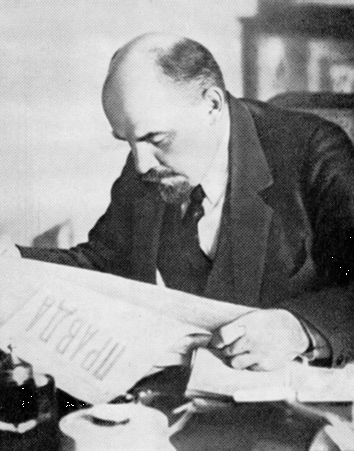
In October 2013, Hannah Sell (Deputy General Secretary of the Socialist Party/CWI) came to my West London branch to do a talk on democratic centralism, laying down the Party line ‘interpretation’ of democratic centralism. Knowing that this was directly aimed at me and the opposition comrades, I took it upon myself to record this meeting, and you can find the recording here:
Early on, Hannah Sell correctly identifies the bureaucratic centralism of the SWP, which she says is “extremely top down, doesn’t allow free discussion, moves to takes organisational measures against opposition, only allows factions for the three months before their conference.” The irony is that all these things also describe how Hannah and the EC have acted towards me, Bruce Wallace and others. In fact, in practice the SP does not entertain factions at all, since me and others asked multiple times about forming a faction, including in this meeting, but never received a response. Hence we were forced to declare a faction openly via this website.
Devious Lenin?
I and the Marxist World faction are in favour of open debate on theoretical issues in front of the class we are trying to win over. What do we have to lose from a debate? Unfortunately, Hannah Sell and the EC believe in the opposite – that the Party should debate behind closed doors, and then once ‘agreed’ on one position should present a single homogeneous view of ideas to the working class. No public debate should be allowed and alternative positions to the leadership should not be aired publicly – or at least only allowed when the leadership decide so. This is, of course, completely anti-Leninist nonsense. In a non-revolutionary situation, the emphasis of the Party should very much be on theoretical clarity to prepare for the next period, which inevitability means open tendencies forming, not permanently, but from time to time as ideas are discussed and clarified. These tendencies would be allowed space in public Party material as a right. The Socialist Party do not allow this.
Hannah’s first argument about Lenin and the Bolsheviks on open debate begins at 19m 26 secs in. At 20m and 10s in, Sell says this:
“Usually when people talk about Lenin favouring complete openness… they are quoting him from 1906… but he did so when the Mensheviks … and the Bolsheviks were in one broad party, the RSDLP. And at that point in time the Mensheviks had a majority in the leadership, and so get to argue a clear revolutionary programme… it was absolutely correct to argue for openness and democracy. But if you read him [Lenin] in 1912, on whether debates should be allowed in public, after the Bolsheviks and Mensheviks split, and he’s talking about debates within the Bolsheviks [as a] revolutionary party, he takes a different approach.”
So according to Hannahl, Lenin was in fact only using open debate as a temporary tactic to gain support within the Party! Once Lenin had the majority, debate was shut down as it had served its purpose. How devious of Lenin! She goes on to “quote” Lenin in 1912:
“The principle of federation, or of equality for all ‘trends’ shall be unreservedly rejected, and the only principle to be recognised shall be that of loyal submission of the minority to the majority. The minority shall have the right to discuss before the whole Party, disagreements on programme, tactics and organisation in a discussion journal specially published for the purpose, but shall not have the right to publish, in a rival newspaper, pronouncements disruptive of the actions and decisions of the majority.”
Lying about Lenin
So that’s a rather different approach to conducting internal debate, says Hannah. Unfortunately, Hannah “bent the stick” a bit too much there, as I put to her the next day via email:
Dear Hannah,
Thank you for coming to the West London branch last night and outlining the Party’s interpretation of Democratic Centralism. I do, however, have a concern regarding a quote from Lenin that you used to suggest the Bolsheviks did not publish opposing views in debates. You quoted Lenin from two paragraphs and relayed them as one continuous prose:
“[T]he principle of federation, or of equality for all “trends” shall be unreservedly rejected, and the only principle to be recognised shall be that of loyal submission of the minority to the majority.”
“The minority shall have the right to discuss before the whole Party, disagreements on programme, tactics and organisation in a discussion journal specially published for the purpose, but shall not have the right to publish, in a rival newspaper, pronouncements disruptive of the actions and decisions of the majority.”
Without any context, Lenin appears to be saying that minority ‘views’ cannot be put forward publicly. However, if we place the quotes in context, the picture is very different. Both of these quotes are taken from the Report of the C.C. of the R.S.D.L.P. to the Brussels Conference and Instructions to the C.C. Delegation (1914), which can be viewed online here http://www.marxists.org/archive/lenin/works/1914/jun/30.htm
Essentially, at this time there was a minority within the Bolshevik Party (where the Bolsheviks still operated as an ‘illegal’ organisation according to Russian Tsarist law/jurisdiction) that wanted the Bolsheviks to drop their “illegal” activity and programme so they could work fully in the open as a “legal” organisation. This would mean completely changing the programme, strategy and tactics of the organisation. In short, it would “liquidate” the Party, and so this minority became known as the “liquidationists”.
The liquidationist minority were producing a rival newspaper calling for liquidating the party and essentially abandoning revolutionary Marxism. This was clearly against the “unity in action” aspect of democratic centralism, not to mention a potential death knell for Bolshevism! Therefore, Lenin said this regarding the liquidationist minority:
“Social-Democratic workers of every shade of opinion shall forthwith be called upon by all Party organisations, and by all the Party’s publications in all languages, immediately to bring about unity from below, i. e., to form local, illegal Social-Democratic units, organisations and centres, or to join such organisations where they already exist. In this connection, the principle of federation, or of equality for all “trends” shall be unreservedly rejected, and the only principle to be recognised shall be that of loyal submission of the minority to the majority. The number of financial contributions made by workers’ groups to the newspapers of the various trends since 1913, as reported in the legal press, shall be taken as the most accurate though approximate index of the alignment of forces among the various trends in the working-class movement. Consequently, these figures shall be published in all Party publications, which shall advise all Social-Democrats in the localities to be guided by these figures in all practical steps they take, pending the next Congress of the R.S.D.L.P.
In the matter of defining Party membership, the sole criterion shall be membership in an illegal unit, group, or other organisation (local, factory, district organisation, or Social-Democratic group in some legal society), illegal activities in organising meetings, discussing Party decisions and distributing illegal literature.
All groups and “trends” shall immediately issue absolutely clear and definite illegal announcements about this.”
What Lenin is saying is that all “trends” (primarily with reference to the Liquidationists) within the Bolsheviks must accept the illegal party organisation for the maintenance of the revolutionary programme, strategy and tactics. In that sense, no minority trend can break the “unity of action” as agreed by the majority, which is perfectly in line with Lenin’s conception of democratic centralism. He goes on:
“7. The existence of two rival newspapers in the same town or locality shall be absolutely forbidden. The minority shall have the right to discuss before the whole Party, disagreements on programme, tactics and organisation in a discussion journal specially published for the purpose, but shall not have the right to publish, in a rival newspaper, pronouncements disruptive of the actions and decisions of the majority.
Inasmuch as the liquidators’ newspaper in St. Petersburg, which is supported chiefly by bourgeois, not proletarian funds, is published contrary to the will of the acknowledged and indisputable[2] majority of the class-conscious Social-Democratic workers in St. Petersburg, and causes extreme disorganisation by advocating disregard for the will of the majority, it shall be deemed necessary to close this newspaper immediately and to issue a discussion journal in its place.”
Again, in context, the “rival newspaper” refers to trends that break the agreed unity of action (of illegal activity). Specifically, between the illegal Bolshevik majority and the Liquidationist minority who produced a paper openly calling for the Bolsheviks to abandon their organisational method and revolutionary programme. An approximate example to this would be if the Scottish section prior to the split from the CWI had produced a “rival newspaper” calling for the Scottish Socialist Party to abandon the CWI and abandon the revolutionary programme, in parallel with the “official” newspaper adhering to the CWI and the Marxist programme, clearly breaking “unity of action” and threatening the existence of the organisation.
Furthermore, Lenin did not simply want the Liquidationists to censor their views publicly, but merely to shut down their paper. They were still granted publication of their views in a “discussion journal specially published for the purpose”! There is no mention of this journal being internal. In fact, Lenin later says:
“A Social-Democratic discussion journal shall be founded abroad, with funds collected there, for the purpose of discussing from all angles and free of the censorship, questions concerning the programme, tactics and organisation.”
Again, there is no mention of this “discussion journal” as an internal document. The closest example to the Socialist Party of a “discussion journal” would be Socialism Today, which is sold to the public and published online.
However, this does raise the question of whether we need a more theoretical journal, perhaps a quarterly one? According to the Bolsheviks, public discussion and publication of discussion and different views is welcome so long as it does not contradict unity of action.
Therefore, I do not see any parallels with a public debate/publication of alternative views on the cause of capitalist crisis, because it simply does not affect “unity of action”. This is line with democratic centralism as understood by Lenin prior to taking state power in 1917.
I would appreciate a response on this because I believe you have, perhaps unwittingly, misrepresented Lenin’s position on the rights of minorities to express their views publicly, so long as unity in action is not broken.
Comradely,
Steve
(end of email)
Recording Vindicated
As outlined above, Hannah Sell justified the idea that democratic centralism prevented open debate by amalgamating quotes from Lenin and ripping them completely out of context! Now, I only realised this because I recorded what she said and then researched the quotes after the meeting. If this recording had not taken place, there is no way I would have been able to work out that what she said was actually a complete distortion of Lenin. This therefore completely justifies my decision to record the meeting, because it allowed me to research and show the false methods employed by the likes of Hannah Sell and the EC to justify their anti-Bolshevik position. Without this, the membership (including potentially myself!) would simply have accepted what she said as truth. The membership and the class have a right to know, so I have made the recording available as indisputable evidence.
Non- Faction Forming
At 28 minutes in, Hannah says:
“Our Party is not like the SWP. We fully support the right to have disagreements, if you feel it’s necessary to move towards having a tendency, an organised current of disagreement. Even in extremes, go towards founding a faction if serious issues are at stake.”
At 34m 20s in, I made some key points, which I was never given a proper response to but will outline for the record:
“Democratic Centralism was invented by the Mensheviks in 1905 and the Bolsheviks later adopted it… although Lenin criticised the conception the Mensheviks had, which was quite narrow, and Lenin said that comrades should be free to debate and criticise the Party, not just internally, but also in public. The paper they had at the time, Iskra, was not primarily agitational but [theoretical] in terms of views and [presented different] positions…
But even under Stalin’s Soviet Union from 1927 to 1931… there was a public debate on the class nature of China, and that was in the Party material. Now, the debate that is happening on the cause of crisis is not happening in our public material, the EC have published their document publicly on their website and they have not done the same for our one. It denies us of our rights under democratic centralism, which is why we took the decision to publish it online on a blog.
I think the organisational methods that the Party has have largely remained unchanged since the Militant days. I think this is a concern because, understandably when Militant was a semi-secret organisation in the Labour Party [it had to be more conspiratorial]. But I think now with the change in the situation where we’re an independent revolutionary Party - Hannah’s right to say there is a lot of mistrust over political parties… – it’s more important that we try to show how democratic our organisation is. And I think there is nothing wrong with having an open discussion on a theoretical discussion because it does not compromise unity in action [as per democratic centralism]. We still agree with the programme, we go to events, etc….
Also… I just wondered what is the difference between a tendency, grouping and a faction and what are their rights?”
Hannah basically dodged all the points I made.
Hannah Sell’s Lacklustre Response
In reply to my email to Hannah Sell about her distorting Lenin, she had this enlightening message:
Dear Steve,
As I’m sure you agree, it was clear from the discussion at the West London branch meeting I spoke at, you have a different, and in my view completely erroneous, view of democratic centralism than that which has been adhered to and practised by the party throughout its history. This is not only a difference on the history of the Bolshevik party, but also on how democratic centralism applies today. You appear to dismiss the importance of democratic discussion within the party, referring on Facebook to the regional debates which are being planned as “denunciation sessions”, and suggesting that to call them debates is “pathetic”. What do you base this on? The debate which took place in Scotland, which you did not attend, was scrupulously democratic. After both sides of the debate producing documents which were made available to the whole membership, Bruce Wallace, on behalf of the eleven, was given equal time with Peter Taaffe to speak and reply, and was in addition allowed to contribute during the debate. He was listened to politely at all times. At the end of the discussion only one other of the 25+ in attendance supported your position, but that does not reflect any lack of democracy but rather the views of the Scottish section of the CWI.
While you dismiss the efforts of the party to organise, at considerable time and expense, meetings where your views can be put, you instead concentrate on demanding the right to attack the position of the party on Facebook and other social media. Now you are trying to drag Lenin into an attempt to justify your stance.
If you wish to discuss these matters further please submit your views on Lenin and democratic centralism to the members’ bulletin, and they will be published along with a response from the EC.
Yours comradely,
Hannah Sell
For the EC
(end of email)
Well, she gets one thing right, that I am indeed “trying to drag Lenin into an attempt to justify [my] stance” because her and the EC have democratic centralism completely wrong and can only justify it by lying about Lenin!

Leave a Comment